Omnisend AI

 OFFER
OFFER






We compiled real examples of subject lines and emails that get shoppers to stop scrolling during Cyber Monday. The subject lines are grouped by the promise they make and the send times that tend to perform best.
Every example comes from a real inbox, and several are from brands that use Omnisend. That means you can see not only how the emails look, but also the results those programs achieved.
You’ll also find an automated three-email sequence, ready-made templates, and access to our BFCM holiday hub for the wider season.
Quick sign up | No credit card required
Get better sales this Black Friday
Visit our Black Friday hub for articles, videos, podcasts, tools and more to help you succeed
VISIT BFCM HUB
Cyber Monday email templates
A ready-made Cyber Monday email template takes care of spacing, structure, and how the content renders on a phone. The only thing left for you to do is drop in the offer, the dates, and the products.
Omnisend’s template library runs from Valentine’s Day through Black Friday, and every design is responsive and ready to send.
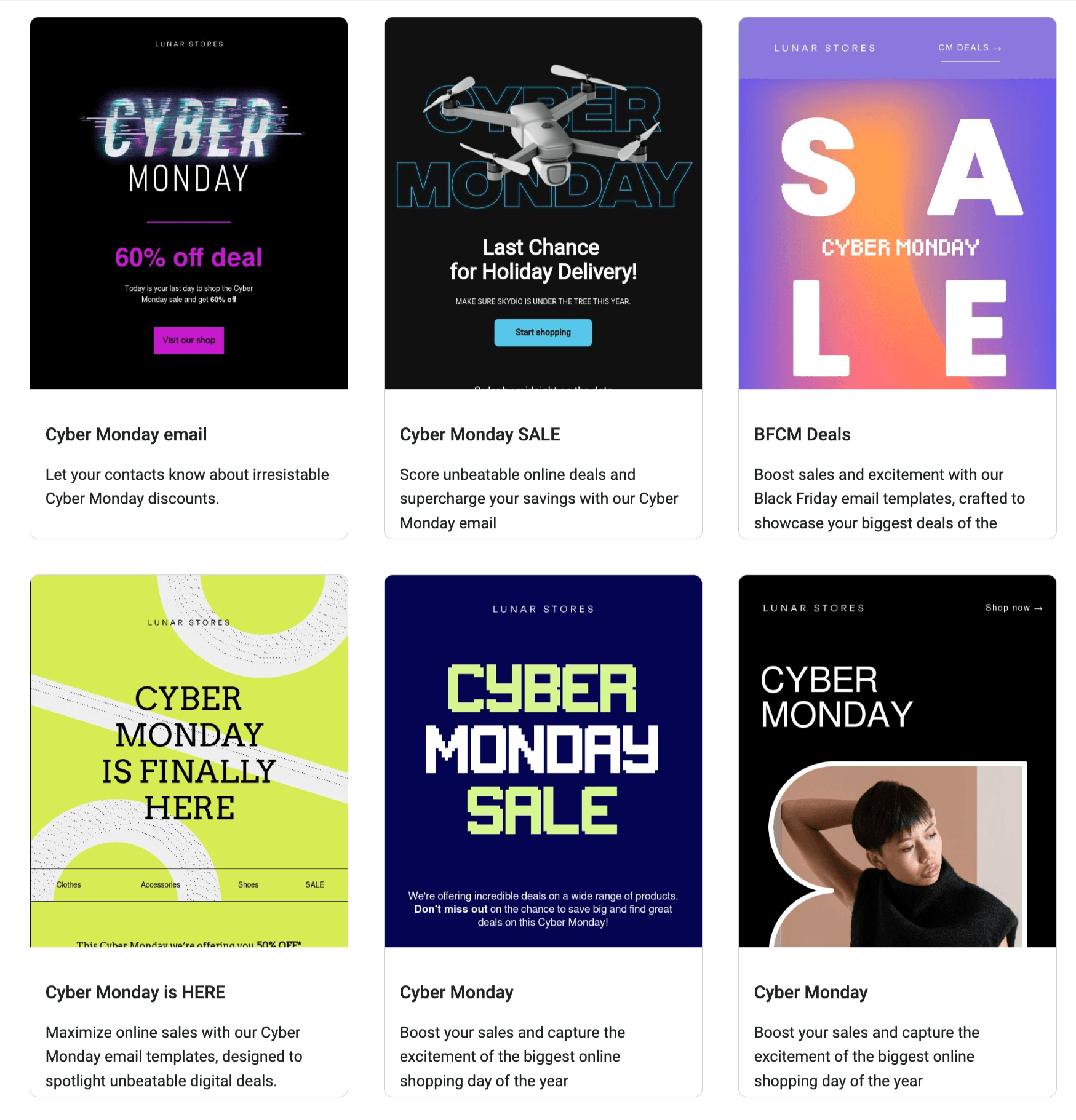
Here are some examples of templates we offer:
Cyber Monday email examples
These eight Cyber Monday email examples start with high urgency and end with a no-discount email. Nearly all of them work across your Black Friday Cyber Monday campaign.
One-day urgency: Kerrits
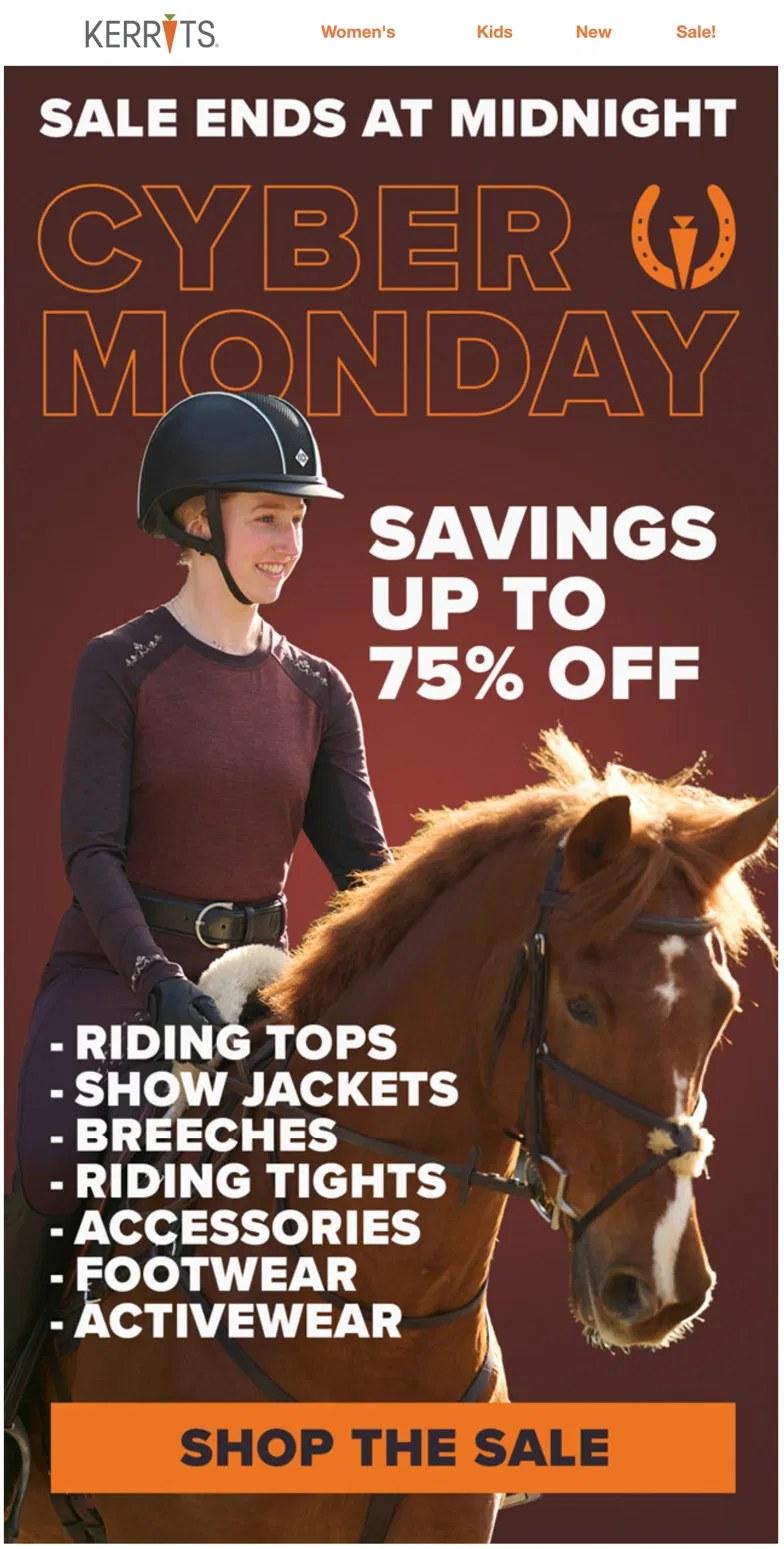
Subject line: 🏃♀️➡️💸 24 Hours to Shop Cyber Monday Deals
Rather than cramming in dozens of deals, Kerrits keeps the message simple. Shoppers immediately know when the sale ends, how much they can save, and which product categories are included. This makes the decision to click much easier.
How to use this example
- Lead with urgency when time is your strongest selling point
- Use category names to make large sales easy to scan
- Give readers one clear path to continue shopping
Kerrits: revenue-per-email up 50%
After moving to Omnisend, Kerrits increased revenue per promotional email by 50%. Automated emails now account for 23% of its email orders, and its welcome and cart abandonment emails generate $6.50 per send.
Read the case study
Turn a deep discount into a mystery: Rachel Riley
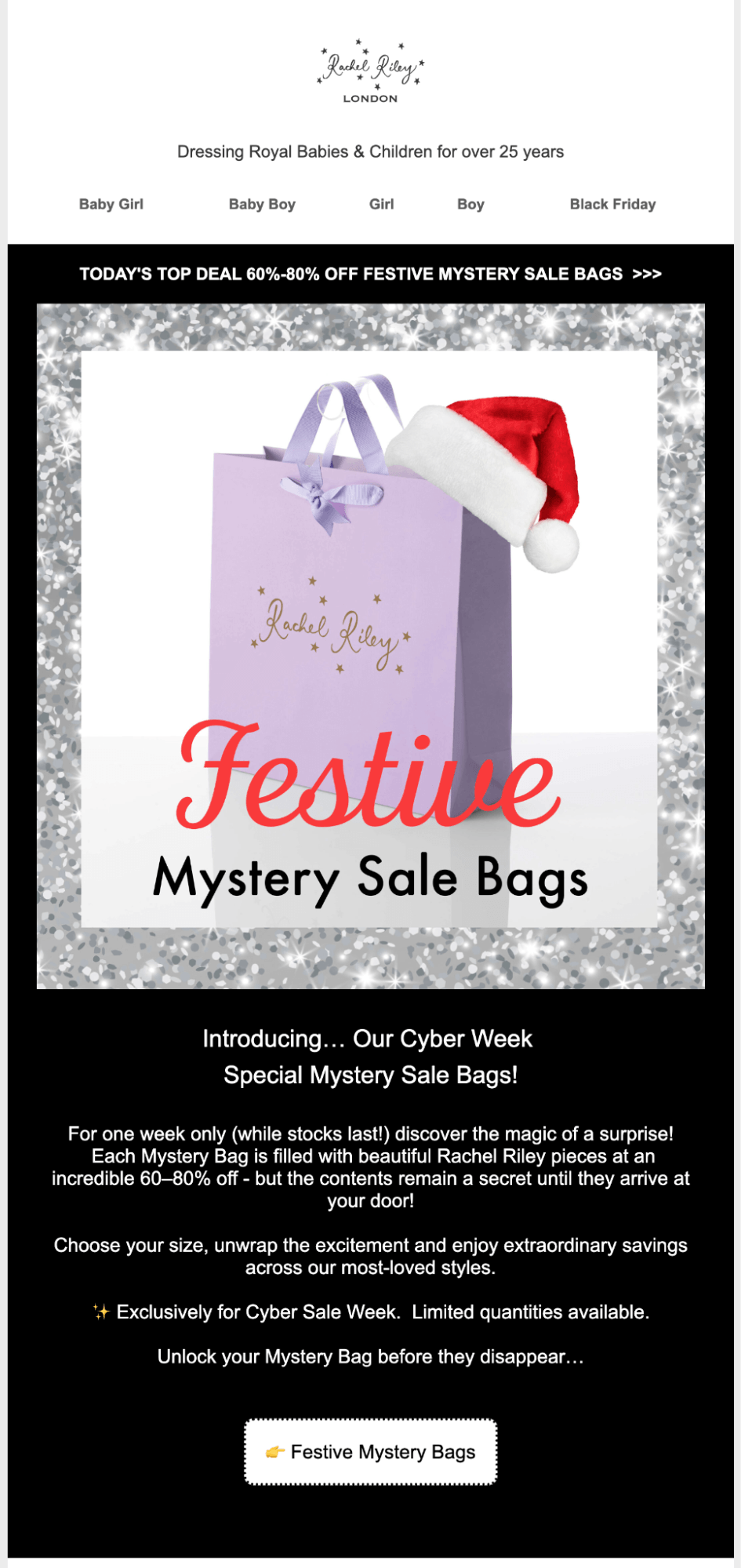
Subject line: CYBER WEEK SPECIAL! Festive Mystery Sale Bags 🎅
Rachel Riley doesn’t show discounted products at all. Instead, shoppers buy a mystery bag at 60% to 80% off, choose a size, and only find out what’s inside when it arrives. The offer runs for one week and ends when the bags are gone.
How to use this example
- Surprise shoppers with curated mystery bags instead of another email full of discounted products
- Offer different bag sizes so shoppers feel they have some control over the purchase
- Keep the promotion believable by using a genuine deadline and limited quantities
Rachel Riley: BFCM revenue grows 77% with Omnisend
Rachel Riley increased BFCM sales through Omnisend by 77.33% year on year. Nearly half of its store revenue came through Omnisend, and automations generated 46% of those sales.
Read the story
Tiered offers in one email: B-Wear
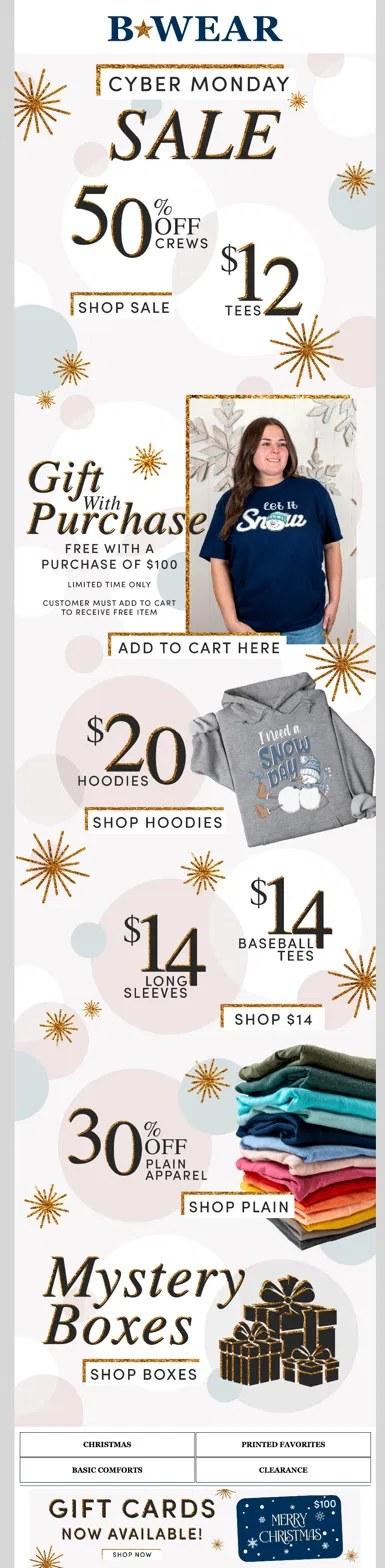
Subject line: Cyber Monday is HERE!
B-Wear stacks several offers into one email and labels each one plainly. The list runs 50% off crews, $12 tees, $20 hoodies, a gift over $100, plain apparel at 30% off, and mystery boxes. Shoppers can quickly spot the offer they want and head straight there.
How to use this example
- Break multiple offers into separate sections instead of combining everything into one block
- Encourage bigger baskets by rewarding shoppers who spend above a set amount
- Avoid a catch-all CTA when shoppers can jump straight to the offer they want
B-Wear: 40% of total sales now come through Omnisend
Omnisend has become a major sales channel for B-Wear, generating 40% of total revenue. Its welcome series converts at 66%, while six months of SMS sales covered almost two years of the platform fees.
Read the full story
Guide a broad catalog with a product grid: MVMT
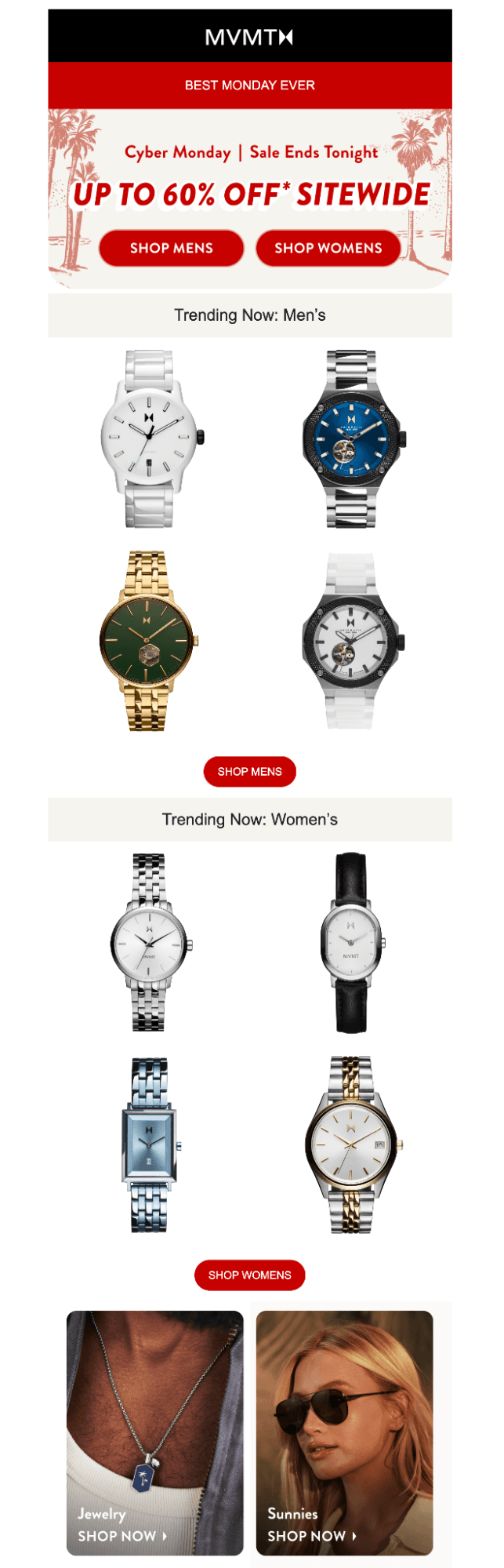
Subject line: Cyber Monday Is Here
You know what the offer is within seconds. After that, MVMT simply helps shoppers get where they want to go. There are separate sections for men and women, a few trending products, and links to the rest of the collection.
How to use this example
- Segment buyers into relevant categories early on so they see products that match their interests
- Highlight a few bestsellers instead of filling the email with your entire catalog
- Keep the key offer above everything else to give the email a clear starting point
Frame the sale as gifting: Snif
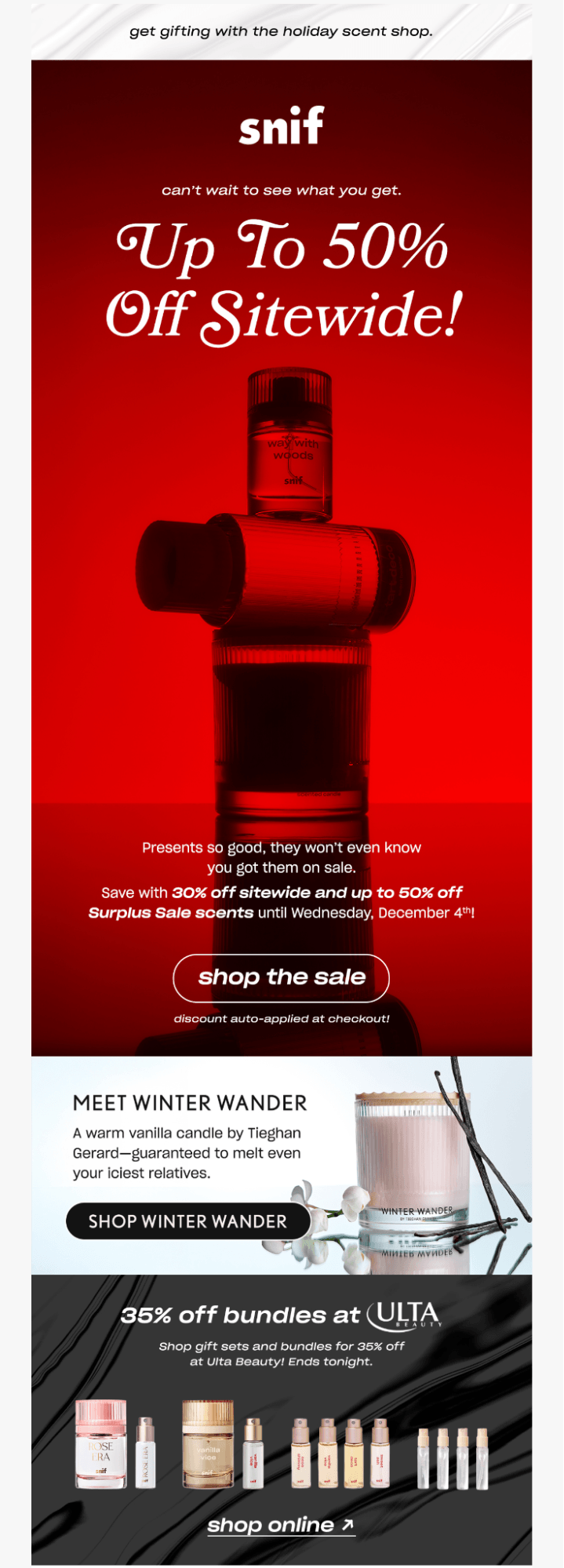
Subject line: UP TO 50% OFF. 🚨
Snif doesn’t ask shoppers to hunt for the best deal. The discount is already waiting at checkout. The email focuses on holiday gifts, and a couple of featured sections help shoppers get started.
How to use this example
- Tie your sale to holiday gifting when shoppers are likely to buy for someone else
- Apply discounts automatically so nobody has to remember or enter a promo code
- Mention retail partners in a small section instead of sending a separate campaign
Extend the deadline: Cuisinart
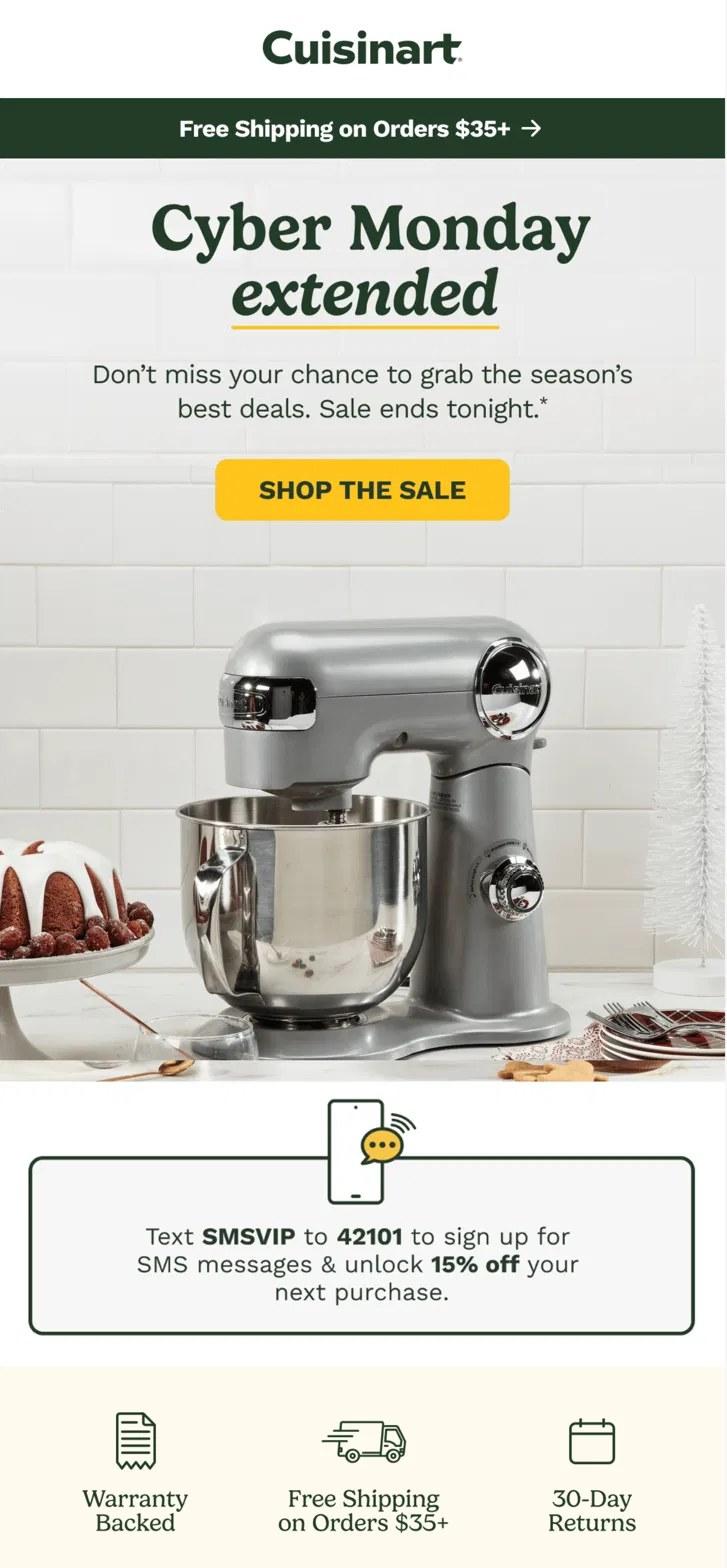
Subject line: Don’t miss Cyber Monday savings
Cuisinart doesn’t add new offers or extra products here. It simply reminds shoppers that the extended sale ends tonight. It then backs that message with one CTA, an SMS offer, and a few trust signals.
How to use this example
- Make the closing date the headline when you’re sending a final reminder
- Keep the email focused on one offer, so shoppers know exactly what to do next
- Treat the extension send as an SMS opt-in moment, with a small incentive attached
Extension sale with a human voice: Blume
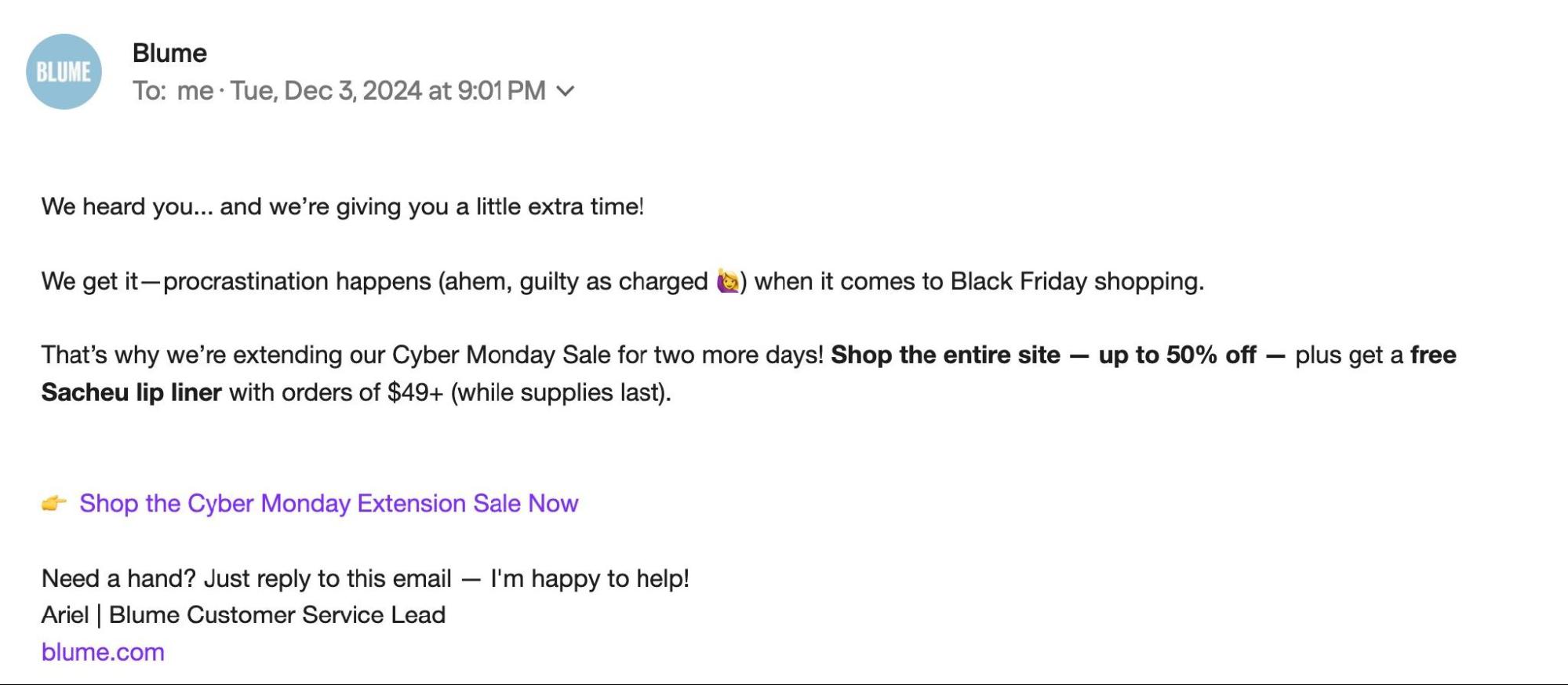
Subject line: EXTENDED: Up to 50% off 🥵
Blume sends a plain-text note signed by a named person. It admits people put things off, gives them two more days, and adds a free gift over a spend threshold. It reads like a message from a colleague rather than a marketing email.
How to use this example
- A signed note can stand out in an inbox full of promotional emails
- Tell shoppers why they’re getting extra time instead of simply changing the deadline
- Offer a free gift once shoppers reach a minimum spend to protect your margins
The no-discount email: Amundsen
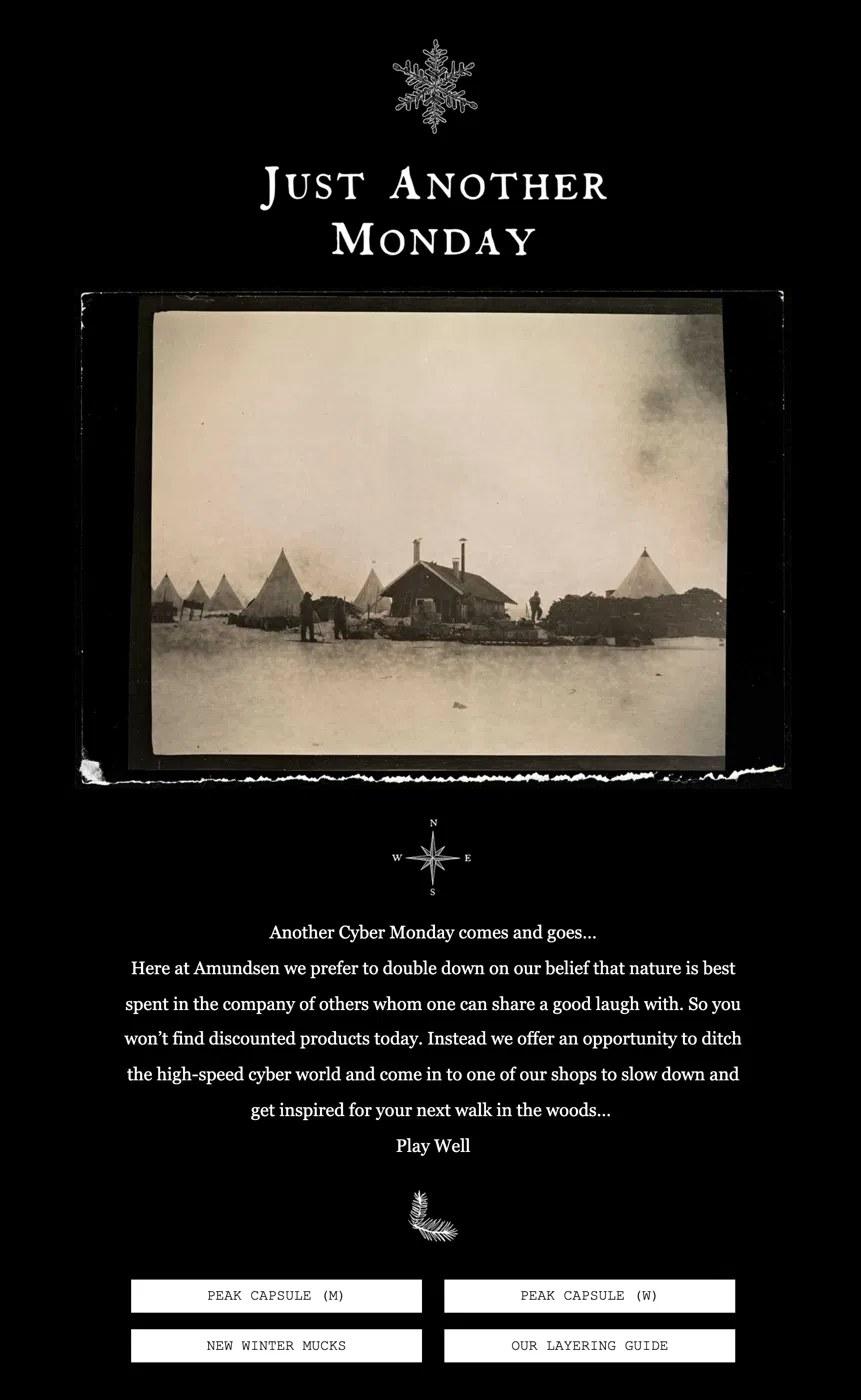
Subject line: Just Another Monday ❄️
Amundsen takes a different approach on Cyber Monday. The email skips discounts altogether and relies on a simple brand message, one vintage image, and links to full-price shopping.
How to use this example
- Only take this approach if shoppers already understand what your brand stands for
- Explain why you’re skipping the sale before asking people to shop at full price
- Resist adding promotional elements that weaken the message you’re trying to make
Amundsen: Order confirmation emails became a major revenue driver
Amundsen increased revenue per email from automated campaigns by 1,010%. Automations now generate 30% of its Omnisend sales, while order confirmations alone contribute 17% of annual revenue driven by Omnisend.
See the full case study
Cyber Monday email subject lines
With inboxes packed on Cyber Monday, a few well-chosen words often outperform a longer headline. Aim for two to six words so nothing gets cut off on a phone.
The examples below are organized by intent instead of style. Test a few different approaches with a small group before rolling out the winning version.
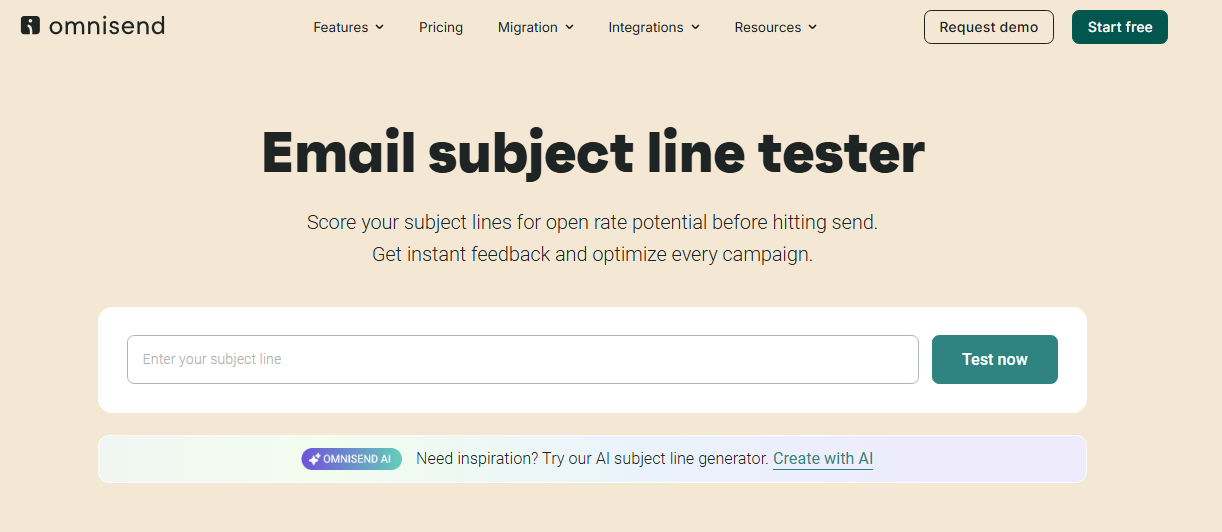
Omnisend’s subject line tester lets you test different options and see which version resonates best with your audience.
Here are proven Cyber Monday subject line formulas organized by strategy, with copy-ready examples you can adapt:
Urgency
Urgency-based subject lines create immediate pressure to open and act by suggesting that delay will result in missed opportunities. These work especially well for same-day or limited-time offers where the time constraint is real and meaningful.
The psychological principle behind urgency marketing is scarcity bias, where people assign higher value to things that appear to be in limited supply or available only for a limited time.
“⏰ 6 Hours Only: Your Exclusive Cyber Monday Gift”
“Last Chance: The Cyber Monday Deal You’ve Been Waiting For”
“Warning: These Cyber Monday Deals Are Selling Fast”
“The 3-Hour Flash Deal You Can’t Miss”
“Your Cyber Monday Rewards Expire Tonight”
“Don’t Open This Unless You Love Savings”
VIP/early access
VIP messaging makes customers feel special while creating exclusivity around your offers. This taps into the psychological principle that people value what seems exclusive or limited to select groups.
These subject lines work particularly well for loyalty program members, repeat customers, or subscribers who have shown high engagement with previous campaigns.
“🔑 Your VIP Early Access to Cyber Monday”
“(Name), Don’t Miss Your Personal Cyber Monday Deal”
“You’re Invited: Our Most Exclusive Cyber Monday Yet”
“🔐 Your Private Cyber Monday Access Code Inside”
“The Cyber Monday Deals We’re Keeping Secret”
“Ready? Your Cart Gets an Extra 30% Off Today”
Delivery/cutoffs
Delivery-focused subject lines are particularly effective for physical products, where shipping deadlines are crucial for holiday gifting. However, they also create urgency around service delivery or digital product access.
These subject lines shift focus from discount savings to time-sensitive logistics, often proving more encouraging for customers who prioritize convenience and reliability over price.
“⚡ Order by Midnight: Guaranteed Holiday Delivery”
“48 Hours Left for Christmas Delivery”
“Your Last Day for Free Holiday Shipping”
“Cyber Monday Cutoff: Order Today, Deliver by Dec 24”
“Express Shipping Ends Tonight”
“Final Hours for Holiday Arrival”
Bundles/threshold offers
Bundle and threshold messaging encourages larger purchases while clearly communicating the value proposition. This makes customers feel good about spending more to gain better deals.
These subject lines work particularly well for brands with complementary products or product groupings that customers might naturally purchase together.
The psychology behind bundle offers is anchoring bias. This is where customers compare the bundle deal to the individual product prices, making the combined offer appear more valuable.
“Spend $100, Save 25%: Cyber Monday Only”
“Buy 2, Get 1 Free: Today’s Cyber Monday Special”
“Free Shipping + 20% Off Orders Over $75”
“Triple Points This Cyber Monday”
“Your Bundle Deal: 3 Items for $99”
“Reveal 30% Off with $150+ Orders”
Emoji-light options
Subject lines without emojis can be used to maintain a more professional appearance or avoid potential deliverability issues with certain email clients.
These options maintain impact through strategic word choice and sentence structure rather than visual elements. They rely on language psychology and emotional triggers.
Emoji-free subject lines can actually perform better for certain audiences, particularly B2B customers or more conservative demographics who might view emojis as unprofessional or gimmicky. For example, a 2023 study by Koch et al. found that displaying too many emojis diminishes the credibility of the message.
“This Cyber Monday Offer Beats Black Friday”
“The Cyber Monday Deal That Changes Everything”
“We’ve Added Something Special to Your Cart”
“Your Friends Will Ask Where You Got This Deal”
“The Cyber Monday Sale Everyone’s Talking About”
“Discover Your Mystery Cyber Monday Discount”
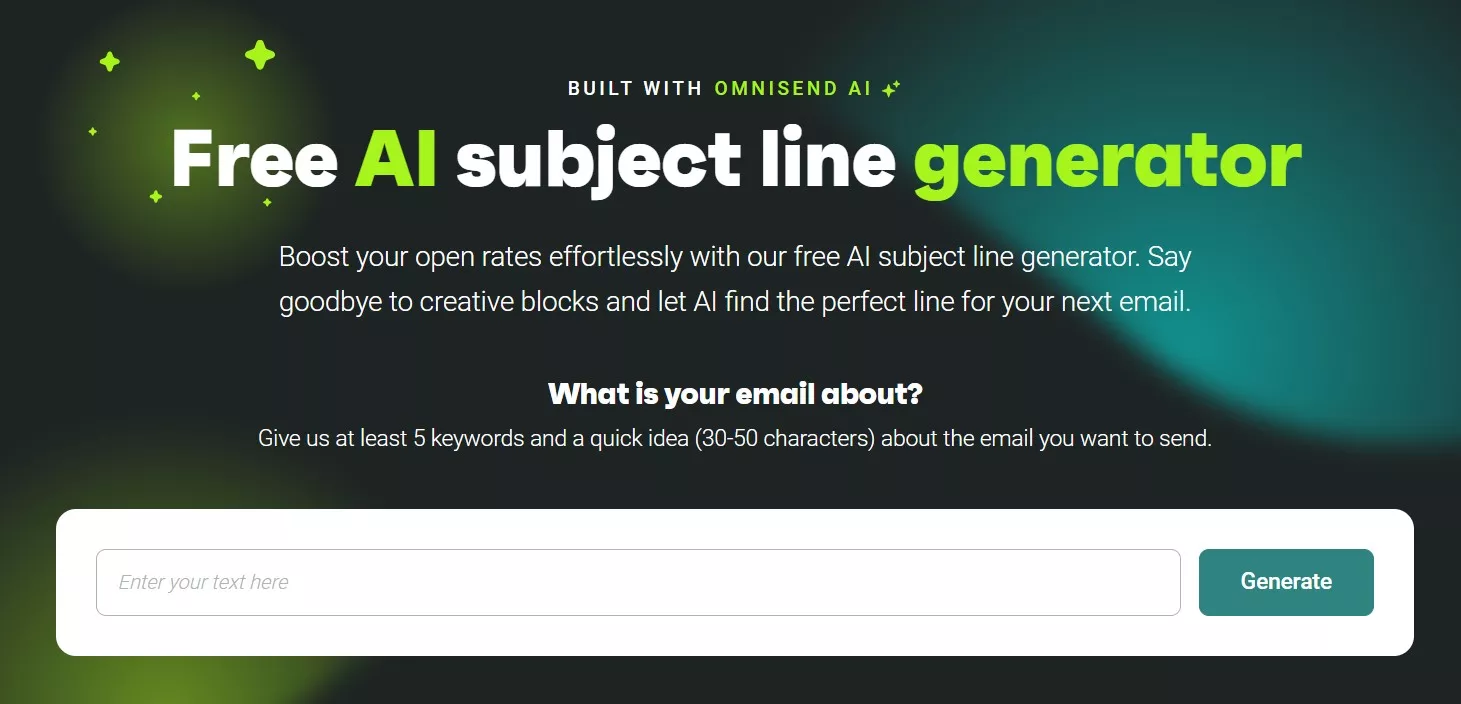
Remember to optimize subject lines with your specific audience in mind. You can use Omnisend’s AI subject line generator to create compelling options that are tailored to your brand’s voice.
When should I hit send?
Research shows the best times to send Cyber Monday emails are 2 PM, 5 PM, and 8 PM in your customers’ local time zones. However, you should test these times with your specific audience since behavior varies by industry and customer demographics.
The extended Cyber Monday period requires a strategic cadence over several days. Start teasing your offers from Friday through Sunday, leading up to Cyber Monday.
Launch your main email campaign Monday morning between 6 AM and 9 AM, then again in the afternoon between 2 PM and 3 PM.
Send your final “last-chance” email Monday evening between 6 PM and 9 PM, with an 8 PM spike often performing best.
Here’s your detailed Cyber Monday email timing playbook with strategic considerations:
- Pre-dawn VIP sends (6–7 AM Monday): Reach early risers and people checking email before work. This works especially well for VIP or early access campaigns targeting your most engaged customers who expect special treatment. These subscribers often check email first thing in the morning and appreciate getting first access to deals. Consider offering exclusive early access or bonus discounts for this segment to reward their loyalty.
- Midday test sends (12–2 PM Monday): Capture lunch-break browsers and people checking personal email during work hours. This timing often sees strong engagement from office workers who use lunch breaks for personal shopping and email checking. The midday send can also serve as a reminder for people who saw your morning email but didn’t have time to shop, providing a second touchpoint.
- Evening push sends (5–8 PM Monday): Hit customers when they’re settling in at home and have time to browse and shop. The 8 PM slot often performs best for final purchase decisions because customers have completed their daily responsibilities and can focus on shopping without distractions. Evening sends also work well for mobile browsing as people relax with their phones.
- Final last chance (8–10 PM Monday): Create final urgency for procrastinators and people who need one more nudge to complete their purchase before offers expire. This send should target people who engaged with previous emails but haven’t yet made purchases. It should use stronger urgency language and potentially include additional incentives, such as free shipping or bonus items, to close the sale.
Remember to use timezone optimization to ensure your emails arrive at the right local time for each customer.
Omnisend’s timezone optimization (TZO) feature automatically adjusts send times based on subscriber locations, maximizing your open rates across different regions.
Also, mobile users check their email throughout the day, so multiple send times can capture different browsing behaviors. Test your timing with small segments first, then scale up your best-performing time slots for maximum impact.
What is the three-email sequence?
A three-email sequence is a type of automation that builds anticipation, launches your main offer, and creates final urgency before your deadline expires. A well-planned email automation sequence captures more Cyber Monday sales than single-blast email marketing campaigns.
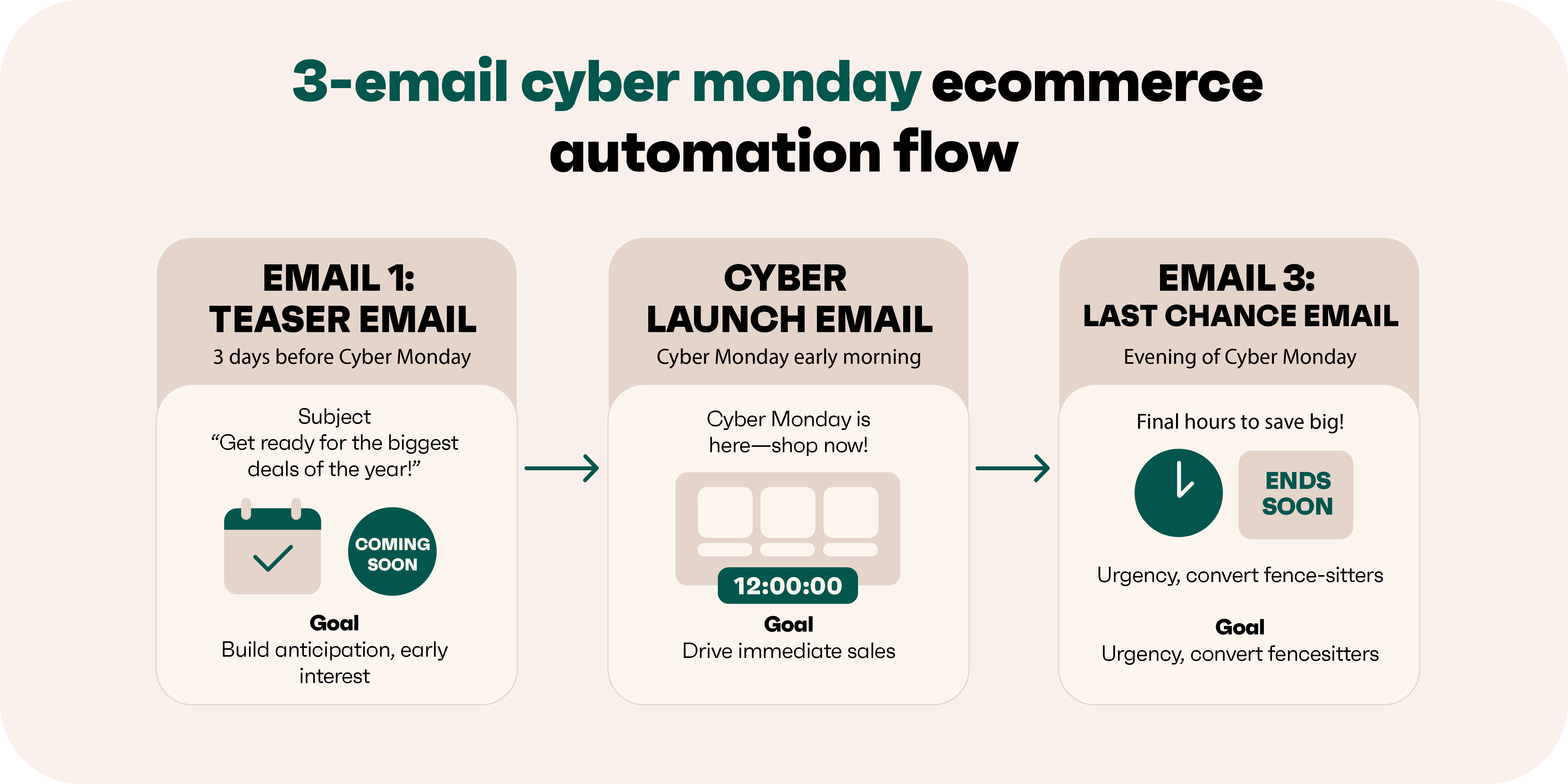
Teaser (Sunday–Monday, pre-Cyber Monday)
Your teaser email should build anticipation without revealing the full offer, creating curiosity that primes customers for the main campaign. Send this 1–2 days before Cyber Monday to warm up your audience and get them thinking about shopping.
| How to set up a teaser email for Cyber Monday? | Explanation |
|---|---|
| Trigger rules | Send to your active subscriber list, excluding recent customers who may not need additional offers or customers who have already received other promotional content recently |
| Segments | Target engaged subscribers who opened emails in the past 30 days for best results, but also create a separate segment for dormant subscribers with different messaging that focuses on re-engagement |
| Subject line angles | Use curiosity-driven lines like "Something big is coming on Monday" or "Your exclusive preview arrives tomorrow" that create anticipation without revealing specific offers or pricing |
| SMS/push reinforcement | Send a short text reminder 24 hours later to subscribers who didn't open the email, using different messaging that complements rather than repeats the email content |
| Order cutoff messaging | Mention that delivery deadlines are approaching for holiday gifts without creating false urgency about your own sale timing, and include general guidance about shipping timelines |
Launch (Monday AM/PM)
Your launch email delivers your main Cyber Monday offer with full details, pricing, and clear calls to action.
| How to set up a launch email for Cyber Monday? | Explanation |
|---|---|
| Trigger rules | Send the morning version to all subscribers and the afternoon version only to non-openers of the morning email to avoid annoying customers who have already engaged with your email |
| Segments | Customize offers based on purchase history, with VIP customers getting exclusive early access or better discounts, or special product bundles not available to general subscribers |
| Subject line angles | Lead with value and urgency using lines like |
| SMS/push reinforcement | Send mobile notifications to high-value customers who haven't engaged after four hours, using different messaging angles that emphasize mobile-specific benefits like easy one-click purchasing |
| Order cutoff messaging | Include specific shipping deadlines and delivery dates for holiday orders, broken down by shipping method and geographic region, to help customers make informed decisions |
Last-call (Monday evening)
Your final Cyber Monday email creates last-chance urgency for customers who haven’t purchased yet, using FOMO strategies and different incentives to convert hesitant customers.
| How to set up a last-call email for Cyber Monday? | Explanation |
|---|---|
| Trigger rules | Send only to subscribers who received previous emails but haven't made a purchase yet, using purchase data to exclude customers who already bought and avoid sending unnecessary messages |
| Segments | Use different urgency levels for engaged vs. less-engaged subscribers, with stronger language and additional incentives for fence-sitters who have shown interest but haven't acted |
| Subject line angles | Create final urgency with lines like "Four hours left" or "Last chance ends at midnight" that include actual countdown elements when possible |
| SMS/push reinforcement | Send final mobile reminders to cart abandoners and previous customers, using direct language that highlights the deadline without being pushy or aggressive |
| Order cutoff messaging | Order cutoff messaging: Emphasize that this is the last opportunity for both Cyber Monday pricing and guaranteed holiday shipping, creating dual urgency around both savings and delivery timing |
This Cyber Monday email sequence lets you capture customers at different decision-making stages while avoiding message fatigue from too many emails.
How do I stay out of spam?
To stay out of the spam box, warm up your domain, control your send volume, clean your list, and keep subject lines honest. High email volume during Cyber Monday increases your risk of landing in spam folders. Major email providers, such as Gmail and Outlook, become more stringent during peak shopping periods when there are increased spam attempts.
Your sender reputation plays a key role in email deliverability during these high-volume periods.
Email providers track how recipients interact with your messages over time, building a score that determines inbox placement. Poor engagement or spam complaints can quickly damage this reputation.
Also, content quality matters just as much as technical setup for avoiding spam filters.
Modern spam detection systems analyze both your sending patterns and message content to make filtering decisions. They look for signs of legitimate business communication versus mass marketing attempts.
Use this Cyber Monday email deliverability checklist to ensure your campaigns reach customers’ inboxes:
- Use a warmed sending domain with a good reputation history
- Remove inactive and bounced email addresses from your lists
- Throttle sending speed to avoid volume-based spam triggers
- Avoid ALL-CAPS text and excessive punctuation marks in subject lines
- Use the email subject line best practices and align the content with your email body message
- Send seed tests to major email providers before full campaign launch
- Monitor your sender reputation and delivery rates during campaigns
- Include clear unsubscribe links and honor requests immediately
Expert tip:
Don’t treat SMS and push as backup channels. They’re there for the moments when waiting a few more hours could cost you the sale. Examples include an abandoned cart that’s about to expire, a shipping cutoff that’s getting close, or the last few hours of Cyber Monday.
There’s no need to bombard people. Start with your email and wait about four hours before texting anyone who hasn’t opened it. Then, send one push notification as the deadline gets close.
Wrap up
Successful Cyber Monday email campaigns combine compelling offers, strategic timing, and professional execution. The brands that win during this critical shopping period understand that preparation and testing make the difference between good results and great ones.
Choose a template, schedule the three-email sequence with timezone optimization, test two or three Cyber Monday subject lines with the Omnisend tester, and add SMS and push notifications for cart abandoners and final deadline reminders.
Start implementing these strategies now to ensure your Cyber Monday email campaign delivers the results your business needs this holiday season.
Quick sign up | No credit card required
FAQs
1. What time to send a Cyber Monday email?
The best times to send a Cyber Monday email are typically 2 PM, 5 PM, and 8 PM in your customers’ local time zone. However, test these windows with your specific audience since behavior varies by industry and customer demographics.
2. What subject lines get the most opens?
Short subject lines between two and six words often perform best. Focus on urgency, personalization, and clear value propositions. Test different approaches using tools like Omnisend’s subject line tester.
3. Is Cyber Monday a real thing?
Yes, Cyber Monday is a legitimate shopping event that started in 2005. It consistently drives billions in online sales each year, making it one of the most important ecommerce days.
4. Should I extend it to Tuesday?
Many brands successfully extend Cyber Monday deals through Tuesday to gain additional sales. Consider calling it “Cyber Week” to set proper expectations with customers about the timeline.
5. Should I email on Friday afternoon or Monday morning?
Send teaser Cyber Monday emails from Friday through Sunday, then launch your main campaign on Monday morning between 6 AM and 9 AM. Follow up with afternoon and evening sends for maximum coverage.
6. Do Cyber Monday emails actually drive revenue?
Yes, for example, Rachel Riley, the British childrenswear label, lifted its Black Friday and Cyber Monday revenue through Omnisend by 77% year over year.
Almost half of everything the store earned across that period arrived through email and SMS. Automations accounted for 46% of it. The three-email sequence and abandonment flows carry most of that load.