
 Omnisend AI


 OFFER
OFFER







Email automation: What it is, how it works & best tools
With over 130+ pre-built integrations and flexible APIs, you can easily centralize data from across your tech stack
Make the most out of your data and unlock powerful growth marketing possibilities with these other top marketing tools.
Build any custom integration with our open, flexible APIs that are simple to use and implement.
Check out apps that have been stealing all the spotlight.
Email and SMS marketing insights, ecommerce resources, and the latest Omnisend news
Expert-led sessions covering email, SMS, and ecommerce marketing strategies.
Educational video and live training to help you make the most out of Omnisend.
Drive sales on autopilot with ecommerce-focused features
See Features
Win-back emails are essential for re-engaging inactive customers, focusing on personalized messaging and incentives to remind them of your brand's value.
Retaining existing customers through win-back campaigns is more cost-effective than acquiring new ones, significantly contributing to long-term profitability.
Successful win-back strategies involve timing and context, utilizing automation to trigger emails based on customer behavior rather than generic schedules.
The average success rate for win-back campaigns can range from 20% to 40%, with reacquired customers often doubling or tripling their lifetime value after returning.
A win-back email re-engages customers who have become inactive or stopped purchasing from your brand. This email must be engaging, reminding customers of your brand’s value. They can also include personalized messaging and incentives to encourage customers to return.
This email is crucial for your business’s long-term growth because it focuses on retaining existing customers. Re-engaging consumers who already know your products or services is more efficient than searching for customers from scratch.
Customer retention helps your business stay profitable. Acquiring a new customer is more expensive than keeping an existing one.
In this guide, we’ll break down the importance of win-back email campaigns. We’ll also cover real-life win-back campaign examples and best practices you can apply to your email marketing strategy.
Win-back emails help maintain a healthy customer lifecycle. As your subscriber email list grows, it’s normal for users to change interests or outgrow a product.
However, instead of seeing a temporary subscriber inactivity as a lost cause, you can send win-back emails to help revive those who are drifting away before the inactivity becomes permanent.
VANHA Digital, a performance marketing agency working with ecommerce brands, treats win-back emails as a crucial part of its email lifecycle. “Email marketing is a pivotal part of our retention strategy, crucial for building community and keeping customers engaged,” says co-founder Theo Van Wyk.
With a win-back email in its email automation workflow, VANHA Digital helped one of its clients generate 35% of its total revenue via email. Across its entire client base, email now accounts for 25%–30% of total revenue.
That said, research shows that marketers send an average of 20% of their emails to inactive subscribers. This means a significant portion of campaigns are going to people who are unlikely to open, click, or convert. Over time, this dilutes engagement metrics, making it harder to pinpoint what’s working.
When inactivity persists, you can send a win-back email as the final checkpoint before removing a subscriber from your list. By making this last effort, you ensure that you don’t end a viable relationship prematurely.
It’s important to note that a win-back email may not result in immediate conversions. The impact can be delayed or indirect, such as gaining insight on a subscriber’s new preferences or a return to your website after a few weeks.
A win-back email works, but only when you implement the best practices. The best win-back emails are personalized and sent at the right time, yielding impactful results.
You can achieve this through email segmentation, where you group subscribers based on similar characteristics. Based on this, you can send a personalized message that resonates with the right person instead of sending the same message to everyone.
The average success rate of win-back campaigns is relatively high. According to WinBack Labs, the probability of winning back a previous customer is between 20% and 40%. For a growing ecommerce brand, re-engaging nearly half of an inactive segment adds to customer retention.
The long-term value of these reacquired customers is even more impactful. The same report indicates that once a customer is won back, their lifetime value can double or even triple. In fact, 47% of returning customers generated more revenue after coming back.
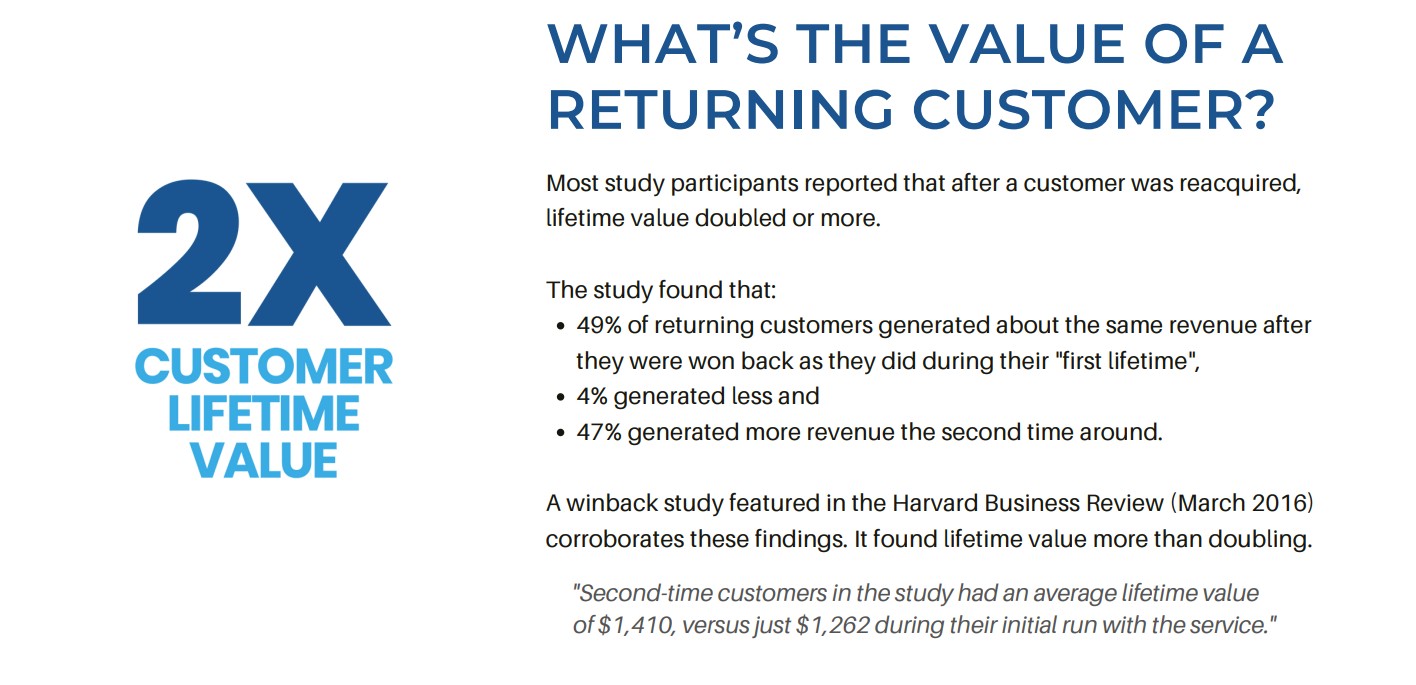
These results are visible in the ecommerce industry. A win-back email can turn a one-off purchase into a sustainable customer relationship.
Consider Blue Drop Studio, a creative agency that helps ecommerce brands scale their operations. Using Omnisend, it helped a client increase email revenue by a staggering 435% in just 30 days.
A key part of this success was its re-engagement flow using Omnisend’s Product Recommender. This feature showed lapsed subscribers items that are specifically tailored to their interests. As Omar from Blue Drop Studio puts it, “If your flows aren’t set up properly, you’re paying to acquire customers you’re not keeping.”
This underscores the idea that win-back emails are necessary for ecommerce stores. “Retention isn’t optional — it’s what makes paid growth sustainable,” shared Omar.
Here are five customer win-back email examples to inspire your next campaign.
Subject line: We miss you 😭
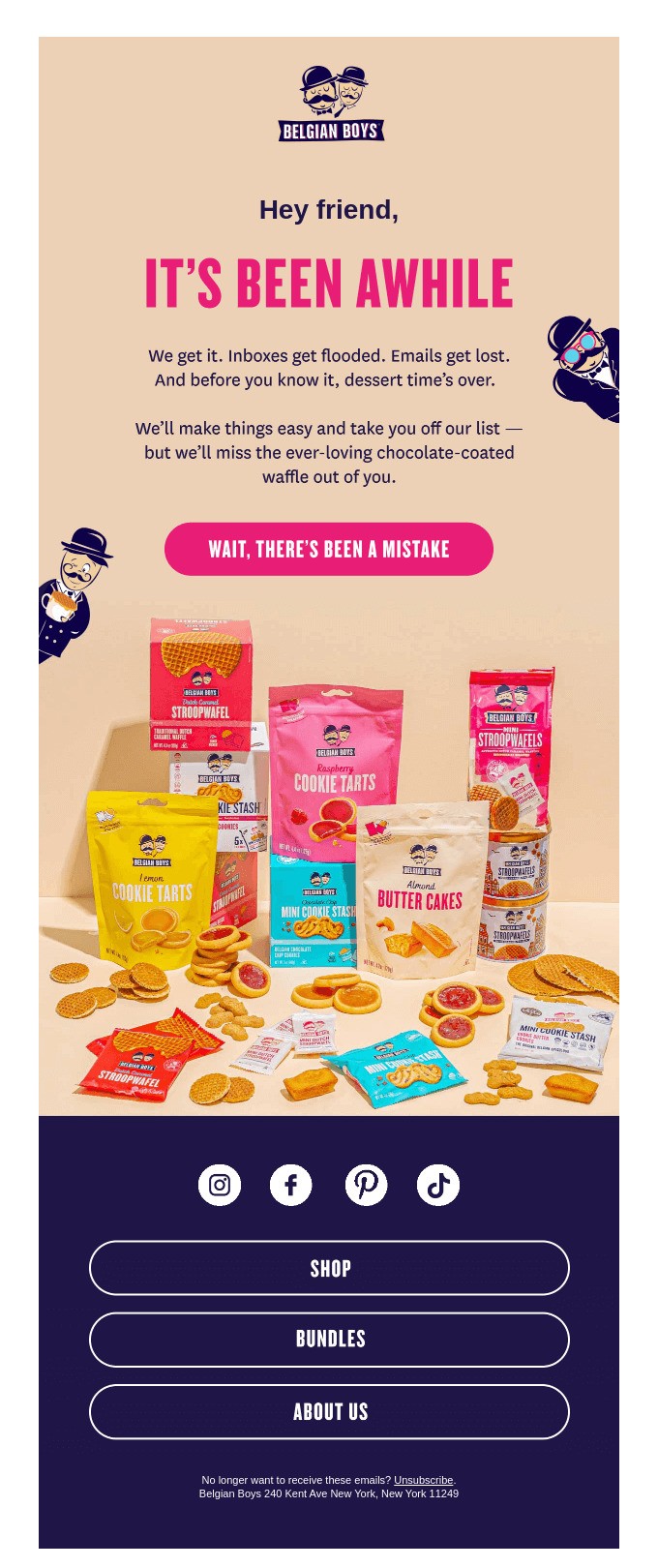
This is a typical “We miss you” win-back email from Belgian Boys. It has an unsubscribe warning twist, which brands use when cleaning email lists.
The copy acknowledges a common subscriber pain point — a flooded inbox — and positions the brand as helpful rather than intrusive. Also, its product image reminds the customer of what they’re missing.
Most importantly, the CTA “Wait, there’s been a mistake,” leverages psychology to encourage a quick click, allowing the subscriber to stay on the list.
Why this email works:
Instead of pushing an incentive, the brand tries to reconnect with subscribers emotionally. It favors brands that have built identity and community. Familiarity with the products and brand personality is more compelling than promotions.
It’s best for customers who have been inactive for 30 to 60 days, where the brand is still fresh in their mind. The CTA also gives the power back to the customer, which can be a great hook.
Subject line: You left. Chormbles stayed.
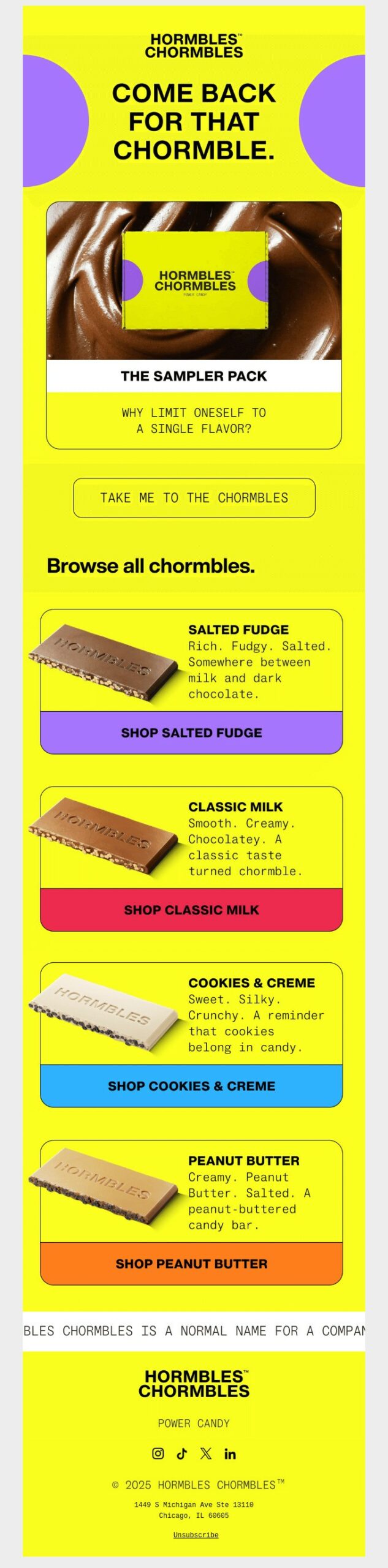
A reminder-based win-back email brings your products back to the forefront of a lapsed customer’s mind. This example from Hormbles Chormbles rekindles desire by showing what the customer liked in the first place.
Additionally, the brand lists specific flavors like Salted Fudge and Peanut Butter with individual “Shop” buttons. This reduces the effort needed to find a product a subscriber loves.
Why this email works:
Unlike a general reminder email template that uses fear of missing out (FOMO) or price cuts, Hormbles Chormbles focuses on product familiarity. Its bright, high-contrast design immediately grabs attention. This makes it an effective win-back tactic for subscribers who are just past your usual buying cycle and starting to drift away.
Subject line: Was Avocode too slow for you?
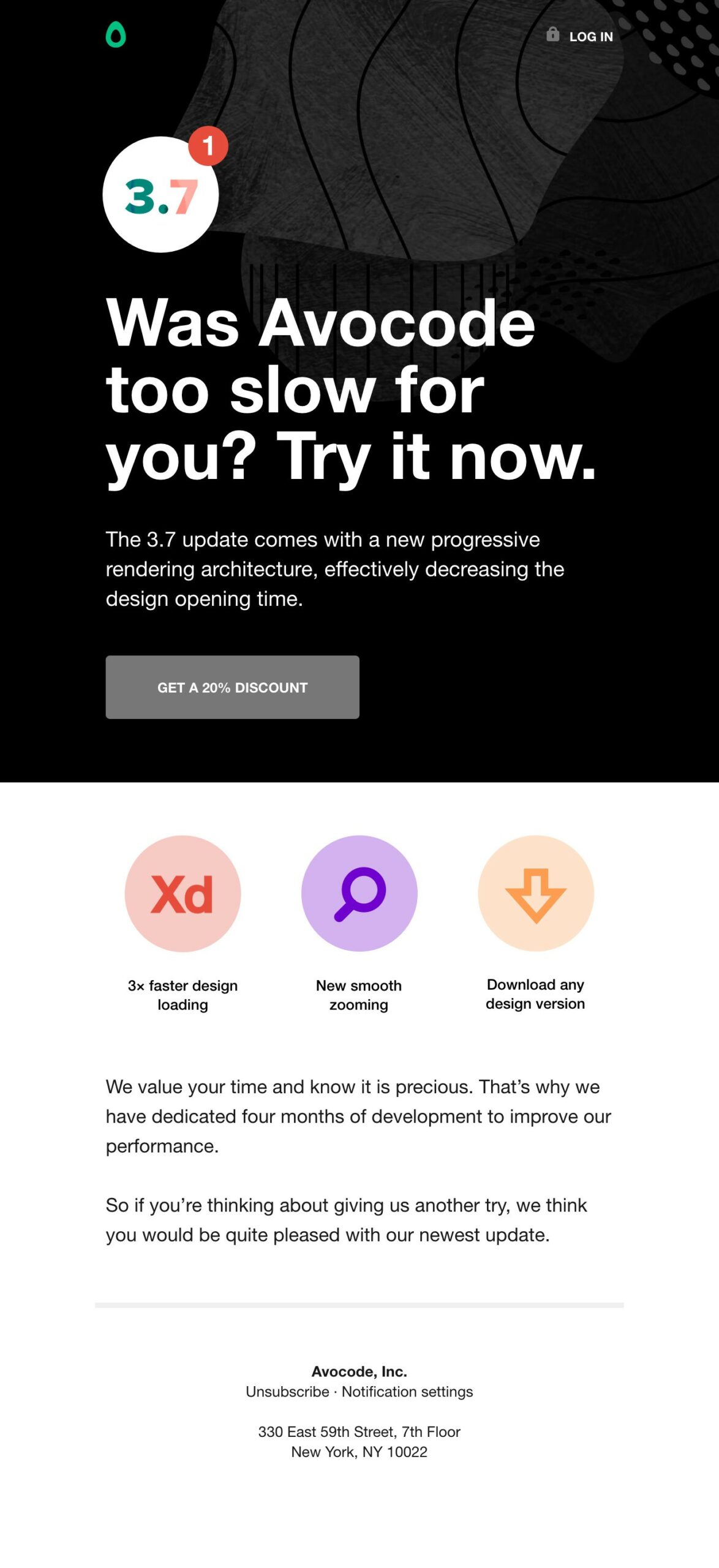
Sometimes, customers may outgrow your product’s features or leave due to technical limitations. That’s the basis of Avocode’s win-back email. It acknowledged that customers may have found its previous version slow.
To re-engage subscribers, the brand notifies them of tangible improvements, such as faster loading. Product updates show that you’ve listened to feedback and improved.
It provides a logical reason for lapsed customers to return and experience a more optimized version of a service.
Why this email works:
This Avocode example is highly effective because it directly tackles a known reason for churn. It then invites customers to try its product after a major performance improvement. Also, there’s a subtle 20% incentive to further encourage customers to return.
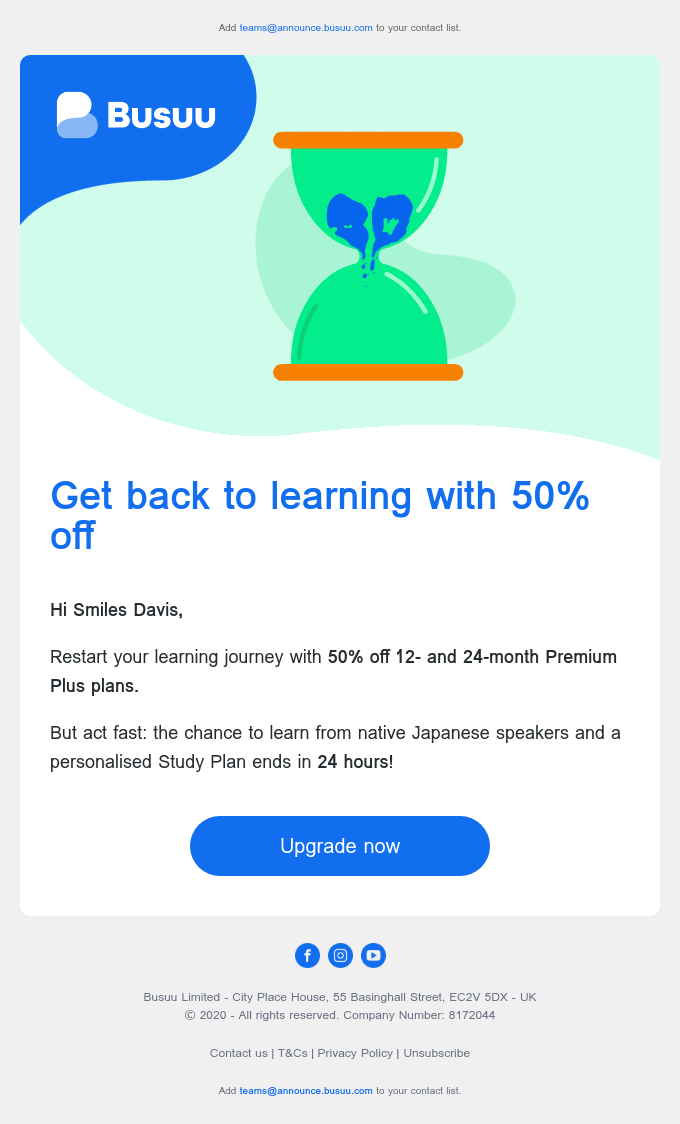
Subject line: Hit reboot on your learning with 50% off 🤖
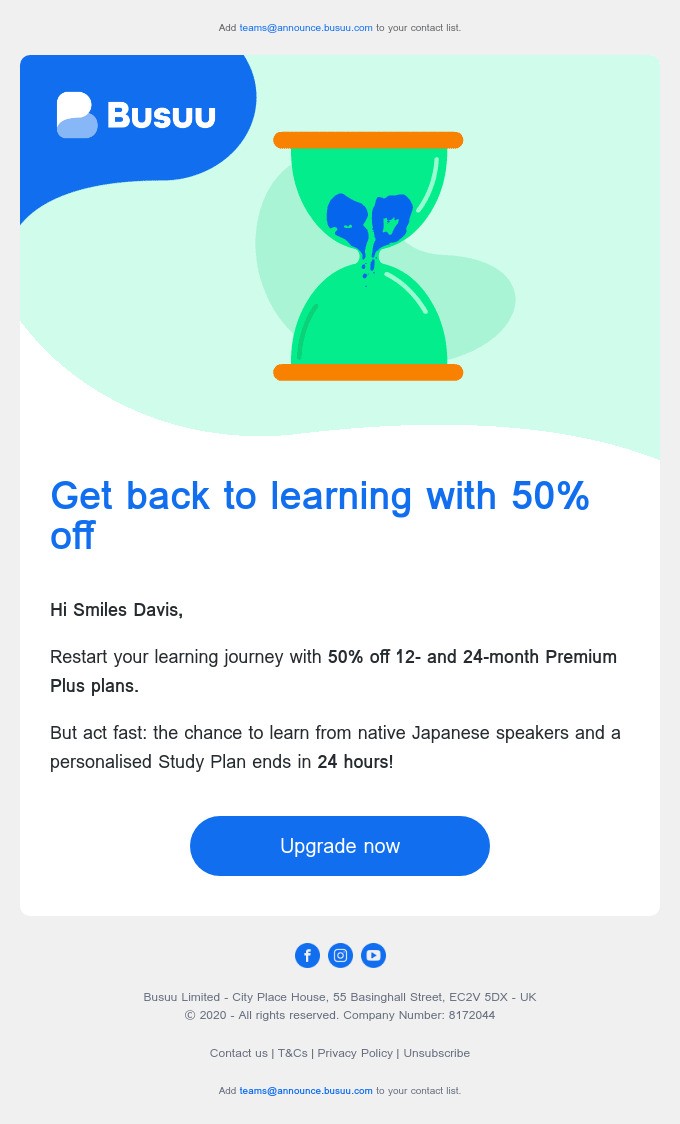
This win-back email from Busuu uses a tangible benefit — 50% off — to motivate subscribers to use its product again. It’s purely an incentive-based email, where the main strategy is highlighting the product’s value and persuading subscribers to make a quick buying decision.
Busuu adds a sense of urgency by stating that the offer will last only 24 hours. It pairs the incentive with an “Upgrade now” CTA. Subscribers can jump back into the experience with just a single click.
Why this email works:
The email positions its offer with a strong sense of urgency. It also lowers the barrier for subscribers to return. It’s especially effective for subscription-based products, where users need financial commitment to continue using the product.
Subject line: We’ll give you 25% off to open this email 🤑
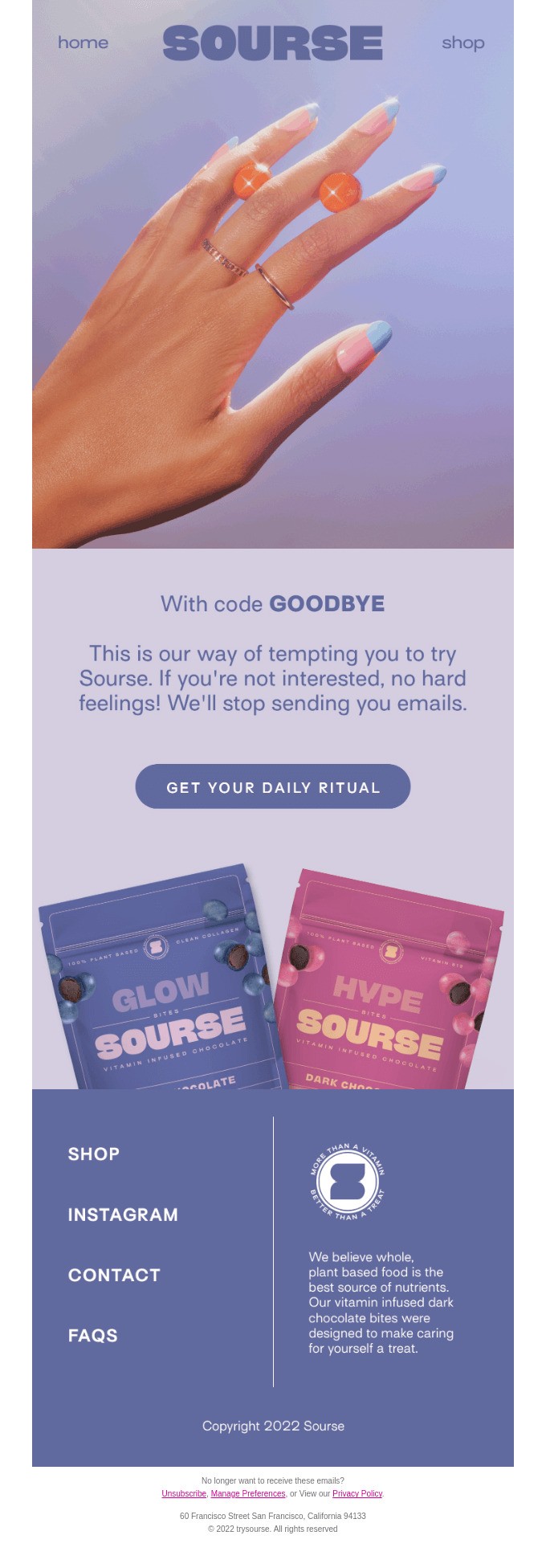
Sourse leads with a bold last chance email subject line: “We’ll give you 25% off to open this email.” This win-back email content urges subscribers to stay connected by using the code: Goodbye. Otherwise, they’ll stop receiving emails from the brand.
A final-chance win-back email is usually the very last communication sent before officially moving a subscriber to an inactive list. By cleaning out your list, you maintain a positive sender reputation and ensure your marketing efforts don’t go to waste.
Why this email works:
This win-back email doesn’t rely on emotional language to re-engage subscribers. Rather, it places its incentive front and center, making it hard to miss. Also, the messaging is transparent, offering a last opportunity to re-engage. It’s ideal for subscribers who have been inactive for a long time and may require a more persuasive reason to return.
There’s no general “right time” to send a win-back email. Instead, it’s triggered based on a customer’s behavior, especially when they’ve become inactive. Here are three scenarios to consider:
After prolonged inactivity
If a subscriber hasn’t opened your email, clicked on your shop link, or used your service between 30 and 90 days, they’re considered inactive. However, they’re not yet churned customers. They’re the ones who have disengaged by canceling a subscription or deliberately stopped buying from your business.
Sending a win-back email too early can feel unnecessary or intrusive. However, waiting too long risks losing the relationship entirely.
After churn or cancellation
A subscriber may cancel their subscription or decide not to use your product at the end of its free trial. You can wait a few days or a week before sending your first win-back email.
At this stage, product updates, new features, or product value messaging work best. They directly address the reasons someone may have left and demonstrate meaningful improvements.
As the final step before suppression
A win-back email acts as a last call before removing inactive subscribers from your list. This gives disengaged contacts one more chance to re-engage before they’re automatically removed.
It protects deliverability and list health by identifying who still wants to hear from you. This reduces the risk of low engagement, spam complaints, and wasted sends to unresponsive contacts.
If you want to put this timing into practice right away, Omnisend’s support guide on Customer Reactivation Automation walks you through building a behavior-triggered win-back flow step by step (including recommended triggers, delays, and basic branching logic). It’s a practical companion to this section — use it to translate your “when to send” rules into an actual automation you can turn on and refine over time.
When NOT to send a win-back email
You shouldn’t send a win-back email when inactivity is recent. Reaching out too soon after a missed open or purchase can feel premature. This may reduce engagement rather than improve it.
Similarly, one-time buyers who showed minimal interaction may not need a win-back email as they haven’t built enough familiarity with your brand yet.
Here’s a summary of which type of win-back email to send based on the period of inactivity:
Or WATCH real win-backs in action
If you want to see what a full win-back setup looks like inside Omnisend (timing, sequencing, and what each email covers), this webinar includes a practical walkthrough of a complete lifecycle flow system — including a dedicated win-back flow as part of the “re-engagement and churn” stage:
A thoughtful, well-timed win-back email focuses on rebuilding interest before resorting to incentives. Consider the following best practices when sending re-engagement emails.
Win-back campaigns should begin with reminders or messages that reintroduce your product and its value proposition. Jumping straight to discounts can train customers to wait for incentives instead of engaging naturally.
Escalation makes sense only after softer messages fail. Then, incentives or urgency can act as a final nudge.
Key takeaway: Adding pressure on subscribers too early reduces long-term value.
Some users are simply busy while others may have lost interest, found the product too expensive, or realized it wasn’t the right fit. Sending the same win-back emails to all inactive subscribers ignores these differences.
A reminder works for busy customers, while a value-led message helps when interest fades. Also, product education or updates can address mismatch-related churn.
Key takeaway: Win-back works best when it’s contextual.
Don’t judge the success of your win-back campaign by immediate opens or clicks alone. Many customers re-engage passively, opening future campaigns or returning weeks later without interacting with the original email.
This delayed engagement still signals success. It’s important to wait before suppressing subscribers.
Key takeaway: Win-back impact can be indirect and delayed.
Automation ensures messages are triggered by real customer behavior, such as inactivity or cancellation. Behavior-based triggers consistently outperform date-based rules because they reach customers when interest still exists, even if it’s fading.
This is where email marketing automation platforms like Omnisend excel. According to Omnisend’s latest report, automated emails made up 2% of total sends but generated 30% of email-driven revenue.
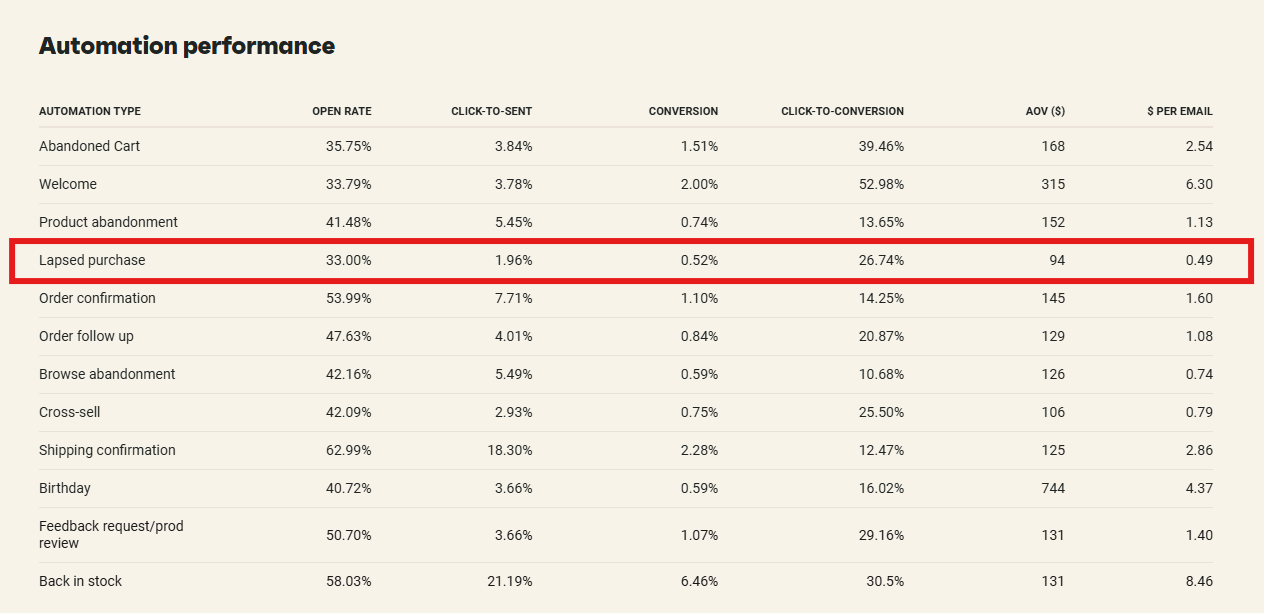
In the same report, the lapsed purchase automation (a classic win-back / reactivation flow) averages 33.00% open rate, 1.96% click-to-send, and 0.52% conversion. The “click-to-conversion” rate is 26.74%, meaning that when people do click, a meaningful chunk goes on to buy. The average order value here is $94, with about $0.49 revenue per email — lower than high-intent flows like abandoned cart, but still valuable because win-back runs on autopilot, scales with list size, and helps you recover revenue from customers who otherwise wouldn’t return. Here’s the visual representation within our Automation performance table:
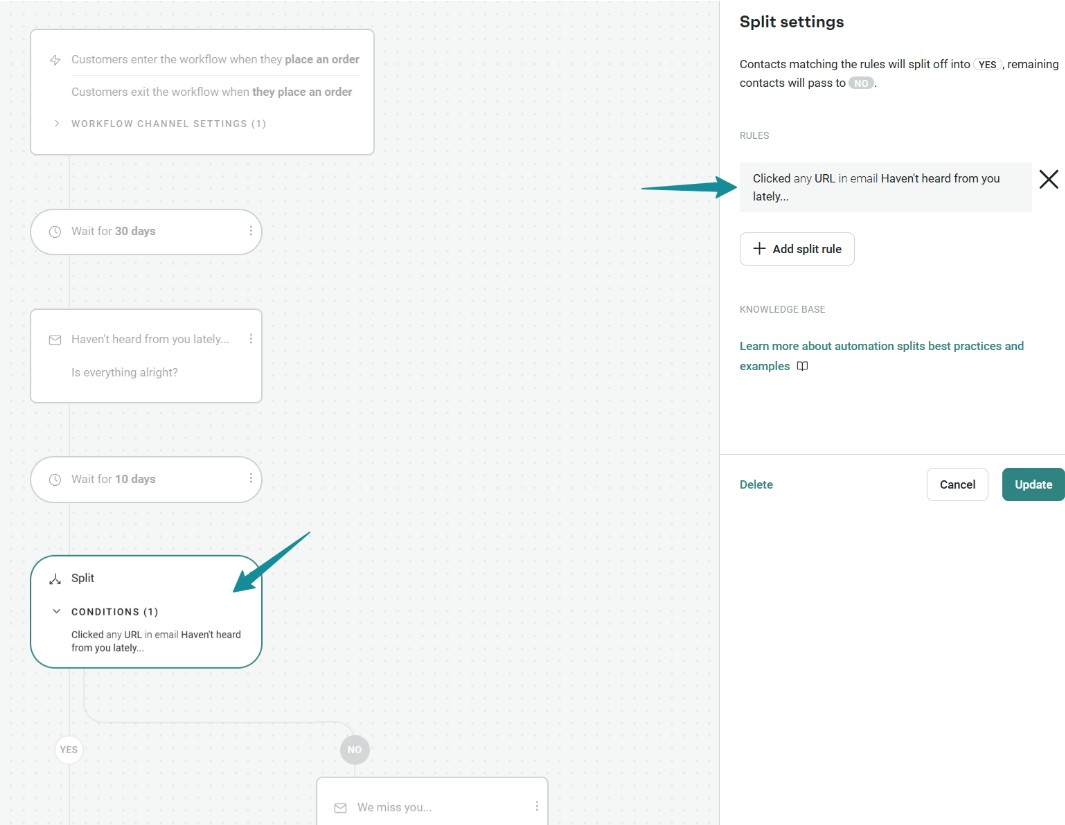
The platform’s drag-and-drop automation builder integrates both email and SMS. This helps you reach customers faster. It also offers pre-built templates for win-back flows, which include split paths and conditional logic.
Win-back emails aren’t designed to force action or rush disengaged subscribers back into a purchase. In many cases, inactivity is temporary. It’s often caused by a change in priorities, timing, or context rather than a complete loss of interest.
An effective win-back email respects where a subscriber is in the customer lifecycle. It recognizes that different situations require different approaches.
When done right, a win-back email strengthens both engagement and list health. They provide opportunities for brands to reconnect when interest is still present or to step back gracefully when it isn’t.
Win-back emails can recover engagement and revenue from inactive customers. They can be highly effective, depending on timing, relevance, and personalization. Customers may lapse temporarily, so well-crafted messages, such as reminders, value updates, or incentives, can reignite interest without the higher cost of acquiring new customers.
There are no limits to the number of win-back emails to send. However, some campaigns perform best with two to four messages. Start with low-pressure, reminder-style emails. Then, escalate to value-led or incentive messages if you don’t get a response.
Ecommerce brands can use win-back emails to recover abandoned shoppers, inactive buyers, or lapsed subscribers. Messages like product updates, personalized recommendations, and past purchase reminders work well.
You can offer discounts in win-back emails, but not as a first step. Doing this too early can train customers to wait for offers before engaging with your brand. Start with reminders or value-focused messaging, then introduce incentives if necessary.

TABLE OF CONTENTS
TABLE OF CONTENTS

What’s next



No fluff, no spam, no corporate filler. Just a friendly letter, twice a month.